A Listening Session Built Around One Instrument
A listening session built around one instrument makes a familiar piece easier to follow. Choose a track, trace its entrances and pauses, then compare its exchanges.
The common mistake in a listening session built around one instrument is trying to track every part at once. The effort can blur the very details you meant to notice: when a sound enters, what it leaves unsaid, and how another part answers it. Pick one instrument as your thread, and let the rest of the music become the setting around it.
This approach works with a familiar recording because you already know its broad shape. Your task is not to identify every instrument or explain the whole piece. It is to notice how one musical voice changes its role over time. Choose a track you can replay easily, use headphones or speakers that let you hear it comfortably, and keep a few lines of notes nearby.
Which listening approach suits you?
There are three useful ways to focus: follow an instrument across the whole piece, study one short passage, or compare that instrument’s exchanges with another part. Each keeps the listening task narrow, but each reveals a different kind of detail.
- Follow the whole piece. Track one instrument from its first appearance to its last. This suits you if you want to understand its changing role, such as whether a piano moves from carrying the melody to filling gaps beneath a singer.
- Study a short passage. Choose a section where the instrument is clear or where something catches your attention. This suits you if a full recording feels crowded, or if you want to notice details such as a held note, a pause, or a change in articulation.
- Listen for exchanges. Follow the target instrument and notice which part seems to answer, interrupt, support, or echo it. This suits you if the piece feels like a conversation, but it asks you to divide your attention more carefully.
Choose the whole-piece approach for a broad arc, a passage for close detail, or exchanges for relationships between parts. You can switch approaches on a later replay, but keep one main question in view during each pass.
How do you choose an instrument you can follow?
Start with the instrument you can recognize most reliably, not the one you think deserves the most attention. A singer’s voice, a drum pattern, a bass line, or a prominent guitar may be easier to follow than a quiet inner part buried in a dense arrangement. The best choice is a sound you can locate again after it pauses.
Listen briefly and ask whether you can describe the sound without relying on its name. You might hear a low, rounded pulse; bright notes that arrive in short bursts; or a sustained tone that bends between pitches. If you lose the sound each time another part gets louder, choose a clearer instrument or a simpler passage.
It is fine to be uncertain about the instrument’s exact identity. Describe what you hear—“low plucked notes” or “a thin, sustained line”—and follow that sound. The listening task depends on attention, not on passing a music quiz.
What should you notice on each replay?
Give each replay one job. On the first pass, listen for entrances and exits: when does the instrument appear, disappear, or return? On the next, attend to pauses. A silence may separate phrases, leave room for another part, or make the return feel more prominent.
Then notice what changes while the instrument remains present. Does it repeat a figure, stretch its notes, become more active, or settle into a supporting pattern? You do not need technical vocabulary. A plain note such as “the short pattern continues while the singer holds a note” records an audible relationship.
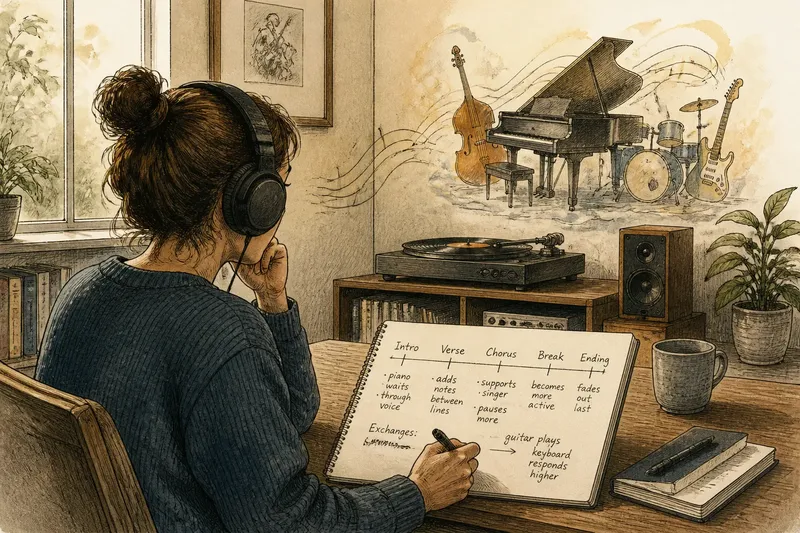
For an invented example, say you choose a familiar song with piano, voice, and drums. On one pass, you note that the piano waits through the opening vocal phrase, adds a few notes between lines, then becomes more active during an instrumental break. On another, you listen for the drums’ steady pulse and hear how the piano’s pauses give that pulse more room. Those observations describe what to listen for; they do not require you to decide what the song means.
How can you follow entrances, pauses, and exchanges?
Use a simple timeline rather than trying to write a full transcription. Mark the piece’s broad sections in order—opening, verse, chorus, break, or ending if those labels fit—and add a short note beside each section. A few words are enough: “enters after voice,” “rests,” “repeats low figure,” or “answers guitar.”
When the instrument pauses, keep listening to the space it leaves. Notice whether another sound takes over, whether the texture grows thinner, or whether the pause makes the next entrance stand out. Avoid assuming that every silence has a dramatic purpose; record the audible change first.
For an exchange, describe the order before interpreting it. “The guitar plays a short phrase; the keyboard responds with two higher notes” is more useful than simply writing “they talk.” If the pattern returns, note what stays the same and what changes. The comparison helps you hear whether the exchange is a repeated feature or a one-time event.
What questions help you listen more closely?
How do I follow an instrument in a busy mix?
Listen for its register, tone, or recurring rhythm rather than trying to separate every note. If the sound vanishes, return to a clearer section and use that as a reference point when the instrument comes back.
Should I use headphones or speakers?
Use whichever lets you listen comfortably and hear the target part without straining. Headphones can make a quiet line easier to locate, while speakers may help you notice how the music fills a room; neither is required.
Do I need to know music theory?
No. Notes about repetition, timing, volume, and pauses are enough to build a useful listening record. Use technical terms only when they help you describe something you can hear.
How many times should I replay the track?
Replay it until the question you chose has a clear answer, then stop or choose a different question. If each pass produces only more guesses, switch to a shorter passage or an easier-to-follow part.
How do you choose between the three approaches?
Let the piece and your purpose decide. If you want to understand how a part changes across the arrangement, follow it through the whole piece. If one moment is difficult to hear, isolate that passage. If the instrument seems to respond to other sounds, focus on exchanges.
Keep your notes descriptive and selective. Write down a few moments that changed how you heard the instrument, not every event in the recording. A compact record makes it easier to replay with a fresh question rather than repeating the same listening pass.
A listening session built around one instrument does not require you to ignore the rest of the music. It gives your attention a reliable place to return, so entrances, pauses, and replies become easier to notice. Once you can describe that part’s path, listen again without the notes and hear how the surrounding sounds reshape it.