How the Theatre Playbill Changed from Notice to Keepsake
Trace how the theatre playbill shifted from a practical notice to a guide, credit list, and keepsake, and learn what its changing format can reveal.
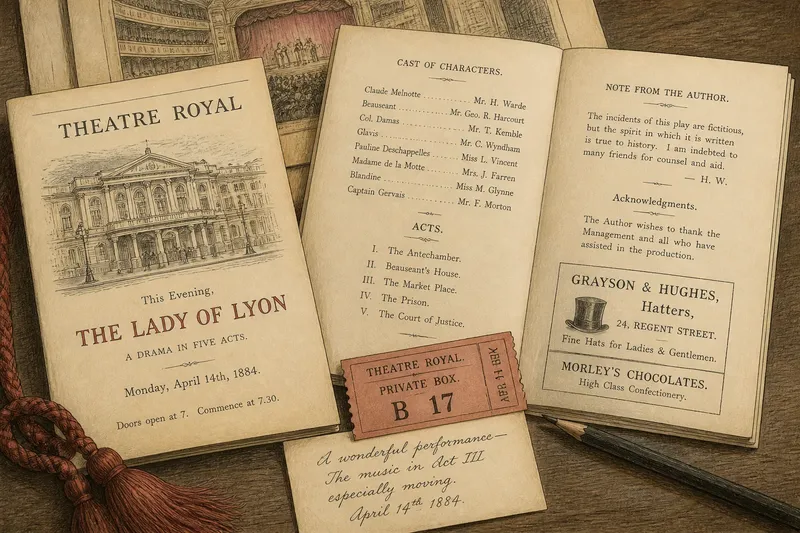
A theatre playbill could once announce a performance in a few lines; later forms gave audiences more to read, keep, and consult. The common mistake is to treat these printed papers as one unchanging object. Their history is better understood as a gradual expansion of purpose, shaped by what theatres wanted audiences to know before, during, and after a performance.
The change was not a single, uniform progression. Playbills and programmes varied by venue and period, and older and newer functions could overlap. A brief notice might still serve as a record, while an elaborate booklet could still help someone find a performer’s name.
What did an early theatre playbill do?
At its most basic, a playbill announced what was being staged and where. A title, venue, and performance information helped prospective audience members decide whether to attend; the printed notice also carried the theatre’s name beyond its doors.
As a performance-night document, the bill could orient an audience with a cast list, roles, or an indication of the order of events. The amount of detail depended on the particular paper. Some bills were brief notices rather than comprehensive accounts of everything that happened onstage.
That distinction matters when reading an old document. A missing name or scene description does not by itself establish that the person or event was absent; the bill may simply have had a narrower job.
How did the programme expand beyond an announcement?
Printed material associated with performances could make room for more than a title and basic notice. Cast and production credits helped identify the people behind a work, while divisions into acts, scenes, or musical numbers could give readers a rough map of the evening.
With additional space, a programme could also present a theatre’s identity and relationships. A note from the creative team might frame a production; acknowledgments could recognize contributors; advertisements could connect the printed object with businesses and services beyond the stage.
These features did not replace the announcement’s practical role. Instead, the programme accumulated functions: it might orient, credit, interpret, and promote within the same set of pages.
Why did programmes become objects people kept?
A programme becomes personally meaningful when its printed details attach to a particular occasion. A date or venue can identify the night; a handwritten note or ticket tucked inside can link the paper to someone’s memory of it.
Format affected how a programme could be used and preserved, though no format guarantees that it would be saved. A folded sheet was easy to carry, while a booklet could accommodate more names and commentary. Even a plain page could acquire significance through a personal annotation or its association with a performance.
Imagine a visitor receives a folded programme for a small production. Before the show, its cast list helps them match roles to names; during the interval, they write down the title of a song they want to remember; afterward, the date and note give them a reason to keep it with the ticket. The result is a single document that has served first as a guide and then as a record of a particular evening.
What can a theatre playbill reveal about its period?
Read the document’s arrangement as evidence of what its publisher chose to foreground, not as a complete portrait of every audience member’s experience. A prominent title makes the production easy to identify, while a dense cast list gives names more space. A long introductory note places interpretive context near the performance details.
Paper size, folds, columns, and type hierarchy also show how the information was arranged for use. A single sheet can present details at a glance; a booklet can give supporting material room to breathe. These choices suggest intended uses, but they do not establish exactly how people handled or read the programme.
Look at what is missing as well as what is printed. A list of performers without explanations may assume readers can follow the action onstage; a credit without a description can identify a contributor without explaining their work. The document records the theatre’s printed frame, not every part of the performance.
Which questions help date and interpret a playbill?
Does an old playbill always list the full cast?
No. A bill may name only selected performers, or use headings that separate roles from production credits. Read the labels and notes before treating an absent name as evidence that someone was not involved.
What can advertisements tell you?
Advertisements show that a programme could carry material beyond the production itself, including connections between a theatre and businesses. Their presence reveals what the publisher placed beside performance information, but not how each audience member responded to it.
Are playbills and programmes the same thing?
The terms can overlap, and their use varies by venue and period. Inspect the contents rather than relying on the title: a document might function as a short announcement, a detailed guide, a record of credits, or a mix.
How can you tell whether a programme belongs to one performance?
Check for a date, venue, cast change, handwritten annotation, or other detail tied to a particular night. A production title alone may identify a show without identifying the specific performance.
How should you read and preserve a playbill today?
Begin with the title, venue, and date, then follow the document in page order. Notice when cast and credits appear, how the performance is divided, and how much space goes to notes, advertisements, or acknowledgments. This sequence helps distinguish a simple announcement from a programme designed to guide or contextualize the evening.
- Check whether a date is printed; if it is, treat it as evidence tied to a performance, and if it is absent, avoid assigning the paper to a specific night without other clues.
- Check whether the venue is named; if it is, record that location, and if it is not, look for other identifying marks before attributing the document to a theatre.
- Check whether names appear under cast or crew headings; if the headings are clear, use them to separate roles from production work, and if they are not, keep the attribution uncertain.
- Check whether acts, scenes, or numbers are listed; if they are, use them as a printed outline, and if they are not, do not infer that the performance lacked divisions.
- Check for a dated insert or handwritten change; if it is present, note whether it appears printed or personal, and if its source is unclear, describe the mark without treating it as official.
- Check the paper for tears, folds, or fragile areas; if it is delicate, handle it minimally and seek a qualified archivist or conservator’s advice, and if it is sturdy, store it flat or folded along existing creases without adding adhesive.
Say you find an undated, folded programme with a theatre name, a cast list, an act division, and a handwritten correction beside one performer. You can identify the venue and describe the printed structure, but the missing date means you cannot assign it to a particular night; because the correction’s author is unknown, record it as handwritten rather than official. The result is a useful description that separates visible evidence from reasonable uncertainty.
Theatre playbill history is not simply a progression from disposable notice to treasured booklet. It is a record of overlapping jobs—announcing, orienting, crediting, framing, and remembering—that a single piece of paper could perform in different combinations. When you encounter one, read its printed sequence first and its personal marks second; that order makes it easier to see both what the theatre supplied and what an owner later added.